

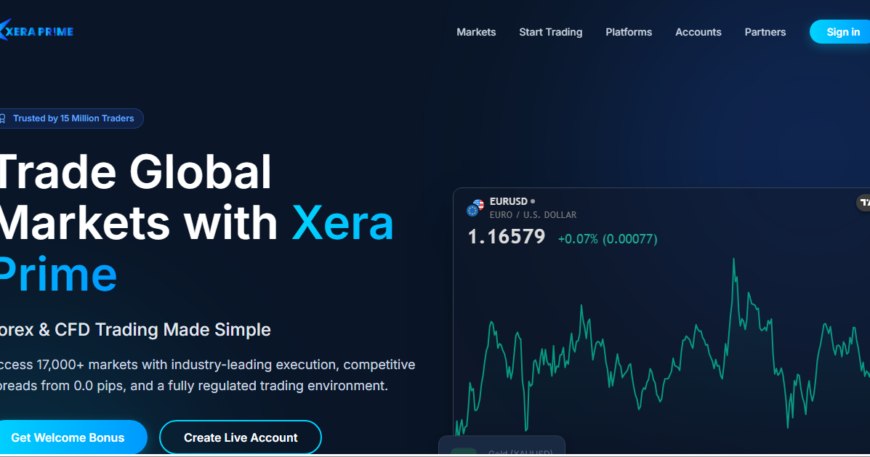
Xera Prime Review: High-Risk Offshore Operations and Transparency Concerns
The retail trading sector features a massive contrast between transparent, highly regulated institutional brokerages and opaque, offshore trading interfaces. A platform that requires significant cautionary screening from retail investors is Xera Prime.
While the platform markets itself with standard fintech buzzwords—promising industry-leading execution, highly competitive asset pricing, and access to deep global liquidity pools—a deep dive into its structural roots reveals substantial regulatory and security vulnerabilities. Operating primarily out of an offshore tax haven with structural ties to highly criticized digital networks, Xera Prime exposes retail capital to elevated risk profiles.
Reclaim Your Crypto Fast
This investigative review analyzes the operational footprint of Xera Prime, explains the risks of trading with an unregulated offshore entity, and outlines essential safety guidelines to protect your investment portfolio.
The Core Vulnerability: Offshore Registration in St. Lucia
The single most pressing factor determining the security of client capital is the regulatory framework under which a broker operates. According to public institutional tracking and company statements, Xera Prime operates out of St. Lucia, a prominent offshore jurisdiction in the Caribbean.
While St. Lucia is home to many international corporations, its local financial supervisory bodies do not maintain the rigorous consumer protection mandates, financial capitalization requirements, or transactional auditing protocols found in Tier-1 jurisdictions (such as the UK’s FCA, Europe’s CySEC, or Australia’s ASIC).
When you route investment capital to an unauthorized offshore platform like Xera Prime, you willingly surrender standard regulatory security mechanisms:
-
No Mandatory Capital Segregation: Top-tier regulators force brokers to store retail user funds inside separate, independent banking institutions. Offshore entities are frequently free to co-mingle customer deposits with daily operating cash, meaning your capital can be directly spent on company overhead or marketing.
-
No Access to Public Ombudsmen: If an offshore broker alters execution feeds, widening spreads to intentionally trigger your stop-loss margins, or simply locks your portfolio dashboard, you have zero recourse. You cannot petition an institutional arbitrator to investigate or force a legal settlement.
-
Absence of Compensation Safety Nets: Legitimate brokerages are bound to national investor protection funds that reimburse traders if the platform files for bankruptcy. An offshore entity operating out of St. Lucia leaves you completely exposed to total capital loss if the platform goes offline.
ATTENTION READ THIS Partners-swiss.com Scam Exposed
Interconnected Networks and the Rebranding Playbook
Cybersecurity firms and digital asset intelligence groups routinely monitor domain footprints to map structural overlaps among offshore trading sites. The name “Xera” has triggered severe algorithmic warnings across international regulatory portals.
A high-profile entity named Xera Pro (operating via xera.pro) was formally blacklisted by the Australian Securities and Investments Commission (ASIC) following global complaints that it functioned as an aggressive multi-level marketing (MLM) Ponzi scheme offering unverified AI trading engines. While Xera Prime positions itself primarily as a traditional multi-asset broker rather than an MLM scheme, utilizing closely paired branding elements under highly opaque offshore registrations is a classic risk indicator.
Predatory platform operators routinely utilize a sequence of parallel sub-domains, altered brand suffixes, or rapid shell company transitions to sidestep regulatory alerts, scrub unfavorable consumer reviews, and continue recruiting unsuspecting retail investors under a fresh visual facade.
Reclaim Your Crypto Fast
Unpacking the Mechanics of Unregulated “B-Book” Trading
Without active, line-item auditing from rigorous financial regulators, offshore platforms frequently run operational frameworks that create an absolute conflict of interest with their clients.
-
Simulated Dashboard Metrics: In an unregulated environment, the trading dashboard provided to a retail user is often an internal piece of software detached from genuine external interbank order books. The platform can alter spread parameters, delay trade execution speeds, or introduce artificial slippage that undermines your trading strategy.
-
The Conflict of “B-Book” Market Making: Many offshore platforms operate exclusively on a “B-Book” execution model. This means the platform does not match your buy or sell order with an external global counterparty; instead, the broker acts as your direct opponent. When your trade loses money, the broker keeps it as pure profit. This setup turns account managers into high-pressure conversion agents whose underlying goal is to prevent you from successfully extracting profits.
-
The Advance-Fee Withdrawal Wall: User feedback tracking offshore broker networks consistently reveals an identical closing trap. When an investor requests a significant withdrawal, the platform halts the transaction. The account manager will then claim that the funds are frozen until the investor wires a separate, upfront cash payment to clear fictitious “local capital gains taxes,” “foreign currency conversion surcharges,” or “liquidity verification fees.” Legitimate entities simply deduct standard operational costs from your existing account balance; demanding external, upfront payments before releasing your money is a verified fraud tactic.
Essential Rules for Retail Investor Protection
If you want to actively navigate forex, indices, equities, or cryptocurrency markets, applying a strict compliance filter is your most dependable line of defense against capital loss:
-
Enforce the “Registry Match” Check: Never trust corporate licensing numbers or regulatory badges stamped on a broker’s footer. Copy the exact entity name or license sequence and cross-reference it directly within official government databases (like the FCA Firm Register, CySEC’s authorized list, or your local national securities regulator).
-
Reject High-Pressure Cold Outreach: Authentic, institutionally backed brokerages do not recruit retail clients through unsolicited direct messages on Telegram, aggressive signal groups on WhatsApp, or lifestyle marketing pitches on social media channels.
-
Say No to Separate Payments: If a trading site tells you that your portfolio balance cannot be accessed until you send them additional cash via bank wire or cryptocurrency to cover taxes, fees, or penalties, do not send a single cent. Sending more capital will not unlock your original account; it merely maximizes your financial damage.
Conclusion: Critical Judgment Regarding Xera Prime
The operational data surrounding xeraprime points to a high-risk conclusion. Relying on an anonymous offshore registration inside St. Lucia—combined with a complete lack of verifiable Tier-1 financial licensing—means that trading on this platform introduces an unacceptable degree of structural risk to your capital.
Reclaim Your Crypto Fast
Do not submit sensitive financial information, government identification scans, or capital transfers to this site. If you have already deposited funds with Xera Prime, you should halt trading activity immediately, preserve all communication logs and digital dashboard receipts, reject any future high-pressure demands for advance fees, and move your trading portfolio to a transparent, locally authorized, and comprehensively regulated institution.

