


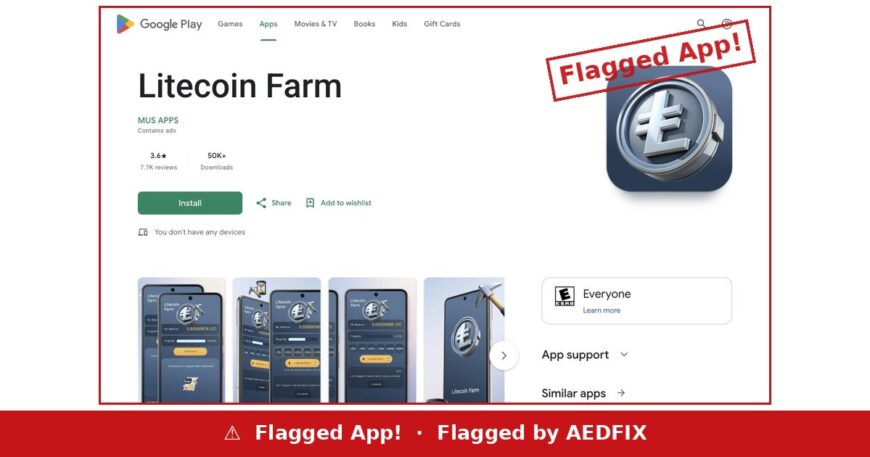
Verdict up front: to withdraw from this app you receive a code, and the code only works in a wallet that costs $10. One reviewer paid, and describes what happened next: the first code worked. Every code after that came back “Invalid code.”
Litecoin Farm is published by MUS APPS. On the day we checked it showed 3.6 stars from 7,700 reviews and 50,000+ downloads, with ads.
What it promises
No simulation disclaimer. The listing sells passive income in plain terms:
From the store listing
“No Investments Required: Start getting LTC without needing to invest your own money. Just start earning cryptocurrency!… Passive Income: Get coin even while you sleep or go about your day.”
“No investments required” is the specific claim worth holding onto, because of what the withdrawal actually requires.
The $10 wallet, and the code that stopped working
So Cleva, 5 May 2026, five people found it helpful. This is the clearest description of the mechanic we have found anywhere in this series:
A user’s account of the payout
“Upon reaching the amount of LTC to withdraw a code number appears. That code has to be inserted into a wallet which costs $10 if you don’t want to wait. I downloaded the wallet and inserted the code into the code area of the wallet. The first code worked and I was able to transfer the first time. But with successive transfers, every code inserted, the system rejected with the message, ‘Invalid code.’ Nice way of earning a quick $10.”
Read the order of events, because the design is in the sequence.
You are not asked for money at the start. You are asked at the end, when you have a balance and a code in your hand and the only thing standing between you and a payout is ten dollars. That is the moment of maximum willingness to pay.
And then the first transfer works. That is not carelessness on the operator’s part — it is the most important part of the whole structure. A wallet that never works gets one angry review and a refund request. A wallet that works once converts a sceptic into an advocate, justifies the $10, and makes every later failure look like a technical glitch rather than a policy.
By the time the codes start coming back invalid, the money has changed hands and the user is more likely to blame themselves than the app.
A blunter assessment
Lee Dawson, 27 April 2026, put it without the detail:
“if this was real it would actually be awesome. However, it’s not. It is literally just a counter and an advertisement system. Nothing is gained, nor can anything be withdrawn.”
“A counter and an advertisement system” is a fair description of most of the apps in this series. The counter creates the feeling of accumulation. The adverts are the revenue. The withdrawal exists to keep you watching the adverts.
The sixth time we have seen this exact gate
An app that pays nothing until you buy a specific wallet is now a documented pattern across multiple unrelated developers and several currencies. The price varies. The structure does not: accumulate, reach the threshold, receive a code, discover the code needs a wallet, buy the wallet.
“No investments required” on the store page. Ten dollars at the checkout.
- Any wallet you must buy to receive your own money is the scam, whatever it costs.
- One successful payout is a sales technique, not proof. Judge by what happens on the second and third.
- Search the reviews for “code” and “wallet” before installing. Thirty seconds.
- “No investment required” describes the beginning, not the end. Find the end first.
If you have paid for a wallet like this
Do not buy a second one or pay any “reactivation” charge — the invalid code is the product, not a fault. Request a refund through Google Play directly where the purchase went through Play. Screenshot the codes and the error messages. Report it at IC3.gov — reporting is free, and no legitimate service asks you to pay before your money is returned.

