
Verdict up front: Five “AI trading platforms” marketed to Malaysians — Agung Fondholm, Sabahi Yieldstead, Prime Proficrest, Kedah Capvale and Nova Bitvaul — resolve through the same five nameservers, were bought at the same registrar, and had their records changed on the same day. They are one operation wearing five names.
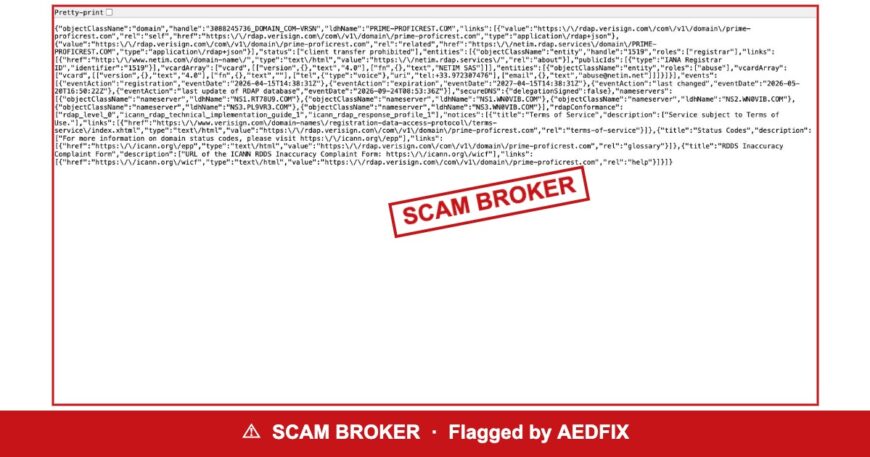
Registration records — checked 24 September 2026
- Shared nameserver set on all five: ns1.rt78u9.com, ns1.wn0vib.com, ns2.wn0vib.com, ns3.pl9vr3.com and ns3.wn0vib.com
- Shared registrar: NETIM SAS · all five records last changed 20 May 2026
- agung-fondholm.com registered 25 March 2026 · sabahi-yieldstead.com 6 April 2026 · prime-proficrest.com 15 April 2026 · kedah-capvale.com 29 March 2026 · nova-bitvaul.com 23 January 2026
- A sixth, fairyieldwick.com (23 February 2026), is also at NETIM on the same style of random-string nameservers
- All six are named on the Securities Commission Malaysia Investor Alert List
- Identical banner figures on four of them: 65+ currencies · 34m verified users · $400m trading volume · 98+ countries
What a shared nameserver set actually proves
A nameserver is the machine that answers “where does this domain live?”. Two unrelated companies can share one by accident if both use a big host — Cloudflare, GoDaddy, AWS — because millions of sites do.
These are not big hosts. The names are random strings: rt78u9, wn0vib, pl9vr3. Nobody arrives at that set by coincidence, and nobody shares it with a competitor. All five domains point at the same five machines, in the same order, bought through the same registrar, and every one of the five records was last modified on 20 May 2026 — the day someone reconfigured the fleet.
The copy gives the same answer
Prime Proficrest: “Experience a new era of trading with our innovative crypto trading platform. With Prime Proficrest’s advanced AI technology, you can optimise your returns and make informed decisions.”
Sabahi Yieldstead: “Experience a new era of trading with our revolutionary crypto trading platform. With Sabahi Yieldstead’s advanced AI trading technology, you can maximise your profits and make informed decisions.” One adjective changed.
Numbers that were never checked
Four of the brands print the same four statistics: 65+ currencies, 34 million verified users, $400 million trading volume, 98+ supported countries.
Thirty-four million verified users would place a platform among the largest exchanges on earth. Four hundred million dollars of volume is a figure the real ones pass before lunch. Divide one by the other and the average user has traded $11.76 in the platform’s entire history. The two numbers were picked to impress separately and never compared.
The artefacts left in the page
Kedah Capvale’s home page contains the sentence “Please paste the text you want proofread.” That is a chatbot’s reply to a prompt, copied into the live site and never removed. The same page writes “34М” using a Cyrillic М rather than a Latin M.
Kedah Capvale carries a second borrowed asset. Under a heading reading THEY TRUST US it displays eight logos — Coinbase, Binance, CoinDesk, TradingView, Deloitte, Ledger, Decrypt and Nansen — and claims no relationship with any of them in any sentence on the page.
Why the count matters more than any one site
Writing about one of these brands describes a website. Writing about five describes a production line: a template, a domain budget, a nameserver fleet and a copywriting step that takes minutes. When one name collects complaints or gets blocked, the next is already registered.
That is why the registration record is worth more than the marketing. The page can be rewritten overnight; the nameserver set is infrastructure, and infrastructure is expensive to move.
- Look up the nameservers before you trust a new platform — any public RDAP or WHOIS lookup shows them free.
- Random-string nameservers at a small registrar, shared across several brands, is a fleet, not a company.
- A domain registered this year cannot have years of history, whatever the page says.
- If four sites print the same statistics, none of them measured anything.
If you have already paid
Stop depositing, and treat any fee, tax or release charge demanded before a withdrawal as the point where the money stops coming back. Screenshot the dashboard, every transfer and the receiving account details. Report it to the Securities Commission Malaysia and to your bank. Then expect a “recovery” service to contact you asking for payment up front — no legitimate one works that way.

