


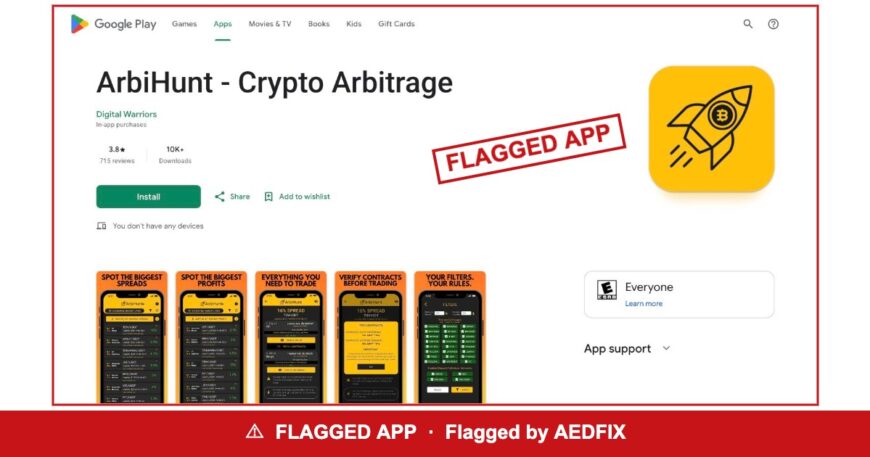
Verdict up front: ArbiHunt opens with “Stop leaving money on the table” and promises something most arbitrage apps do not: an estimated net profit after trading fees and transfer costs. That calculation is the product, it is sold by subscription, and no part of it can be verified from outside the app.
Listing facts — checked 24 September 2026
- App: ArbiHunt — Crypto Arbitrage (com.digitalwarriors.arbihunt)
- Developer: Digital Warriors · 10,000+ downloads · 3.8 stars from 715 reviews · in-app purchases · category Finance · updated 21 September 2026
- Claims: scans 24 cryptocurrency exchanges in real time and surfaces “the arbitrage opportunities that are actually worth your time”
- The differentiator: “calculates your estimated net profit after trading fees and transfer costs”, with liquidity data
- Not disclosed: no fee table used, no transfer-cost assumptions, no slippage model, no company jurisdiction, no regulator and no record of how often an estimate was met
The estimate is doing all the work
Every other arbitrage app shows a spread and leaves the user to work out whether it survives costs. ArbiHunt’s pitch is that it has done that work — which means the number on the screen is no longer raw data, it is a conclusion.
A conclusion can be wrong in ways raw data cannot. Which fee tier did it assume? Maker or taker? Which withdrawal fee, on which network, at what congestion? How much slippage on a book that thin? Change any one of those and a positive estimate becomes a loss. None of the assumptions is published.

Liquidity data is the honest part
Showing how much depth sits behind a price is genuinely useful, and it is the thing most competitors omit. A two per cent gap on a book that can absorb $200 is not an opportunity; it is a rounding error with a trip attached.
But it also frames the risk without removing it. The app is still describing a trade that requires funded accounts on both venues in advance, executed inside a window that closes in seconds while a transfer takes minutes.
3.8 across 715 reviews
That is a middling score for a paid tool, and the shape matters more than the average. In this category the early reviews come from people impressed by the interface; the later ones come from people who tried to capture a listed gap.
The listing publishes no accuracy record — no count of estimates issued, no comparison against outcomes, no distribution of error. For a product whose entire value is the reliability of one number, that absence is the finding.
What to ask before subscribing
Ask which fee schedule the calculation uses and whether it matches your actual tier on each exchange. Ask what transfer time is assumed and what happens to the estimate if the transfer takes ten times longer.
Then test it without money: pick five estimates, record them, and check the real books on both venues at that moment. If the estimates survive that, they are worth paying for. If they do not, you have learned it for free.
- A net-profit estimate is a model, and the assumptions decide the answer.
- Your fee tier is not the app’s assumed fee tier unless you set it.
- Liquidity depth matters more than the percentage.
- Paper-test five estimates before paying for the sixth.
If you have already paid
Cancel the subscription through your Google Play account rather than inside the app, and request a refund from your order history if the charge is recent. Losses from the trades themselves sit with the exchanges you used, so keep those statements separately, and ignore any recovery offer that asks for money up front.

